





|
成為我們的電郵會員(沒有任何費用)可專享每月會員優惠. 請將你的姓名及電郵地址以 WhatsApp (+852 5404 9778)或 Wechat (yanyanlphk) 傳送給我們. |



|
介绍番:  ←按此查看其他文章及中文版本
(所有文章的板權為 Yan Yan LP 擁有,如欲轉載請事先得到我們書面同意。)
我們每個月會請專欄作家高原/保記為我們撰寫專文,介紹與黑膠唱片、鐳射光碟及音向器材有關的資訊。我們希望能夠提供初學者入門的資訊;也希望與資深的朋友交換心得。部份的訊息你有機會看過,但絕對有很多你不知道的資料。我們稱這份為〝介紹番〞,每次初登的時候會放在首頁,之後會放入〝介紹番〞的 Wordpress 內供參閱。
JVC K2 D/A Converter Episode 7
Every modification journey eventually hits a juncture where a single component upgrade forces the rest of the signal chain to adapt or get out of the way. After modifying the JVC K2 D/A converter, I could immediately feel anew-found weight in the low end, accompanied by an ultra-soft, almost overly polite top end.
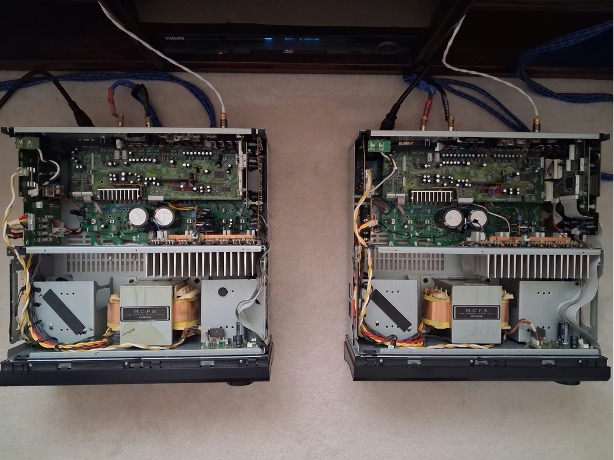
My listening rig centers on a pair of heavily modified Onkyo TX-SR805 receivers in dual mono (please refer to my previous article) driving the classic Spendor LS3/5a monitors. Previously, I had set the power supply voltage on the twin 805s to a middle tier of around 43V (The Onkyo designs automatically switch the B+/B- supply voltage from +/-34V to +/-43V and up to +/-64V), which yielded a rich midrange and a pleasantly mellow treble. But the newly modified K2 was now virtually free of digital glare, rendering my previous gear-taming efforts redundant.
[ JVC K2 DAC ] ──> [ Dual Onkyo TX-SR805 ] ──> [ Spendor LS3/5a ]
I switched the Onkyo receivers to run at a continuous, uncompromising 64V full power, completely bypassing the factory dynamic three-tier switching scheme. The dual amps draw considerably more power and idle significantly hotter, but the result is a rock-solid, seamless delivery. No power-rail switching, no power sag—just pure, uninhibited dynamic swing.
|
|
|
This pair of Onkyo TX-SR805 are now at 64V full steam ahead. |
Five full weeks of run-in later, the modified K2 D/A converter was finally ready for serious evaluation.
The Reference CDs
Drawn in by how convincingly the original JVC RX8030V K2 receiver render natural, analog-sounding strings, I’ve chosen string passages as the primary track for the modified unit. To gauge our progress, first we turned to three distinct string pressings, beginning with the very disc used to benchmark the DAC before its modification:
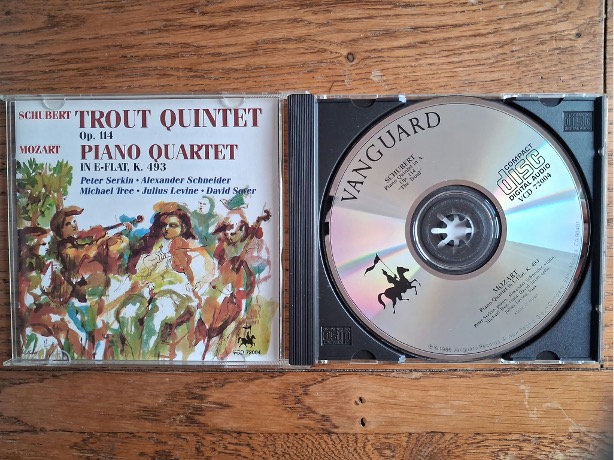
Schubert: Piano Quintet in A Major, D. 667 "Trout" (Vanguard VCD72004)
Schubert’s "Trout": Structural Harmony
The Vanguard early pressing of Schubert's Trout Quintet (Allegretto in 25:10-33:10 Track 1) revealed a transformation that was nothing short of dramatic.
Overall Sonic Character:
The presentation has morphed into something wonderfully refined, smooth, and tonally exquisite. The transient attack is slightly relaxed, but it is supported by a remarkably strong midrange coherence and ensemble blending.
Strings:
Silk-like and continuous. The upper strings exhibit zero grain, edge, or glare, accompanied by a gently rounded attack. Lower strings—the cello/double bass. in particular—are warm, deeply resonant, and grounded, featuring a delightfully natural decay.
Piano Integration:
The piano no longer jumps out of the mix with percussive, pingy hardness. Instead, hammer attacks are softened, revealing the wood and physical resonance of the instrument's soundboard.
Ensemble Balance:
Earlier auditioning (pre-burn-in) yielded artificial separation and hard edges. Now, the K2 delivers organic blending and true musical continuity. It offers less "hi-fi effect" and far more musical truth.
Pre-Burn-in / Unmodified K2: [Hard Edges] ──> [Artificial Separation] ──> [Digital Glare]
Post-Burn-in / Modified K2: [Silky Tone] ──> [Organic Blending] ──> [Analog Flow]
|
|
|
Trout quintet via modified JVC K2 D/A converter (1st section - 00:00) Vs EAC direct transfer from CD (2nd section - 08:05) (Press image to listen on YouTube) |
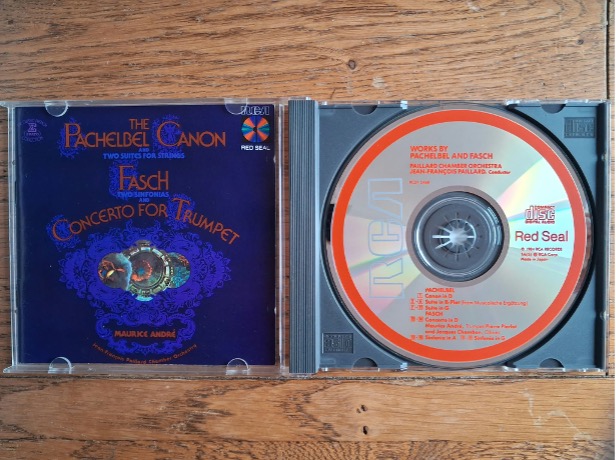
Pachelbel: Canon in D Major / Paillard
RCA/Erato RCD1-5468 (Japan for US First Press, inner ring matrix Denon 1A1 53)
Moving on to the famous Canon, the string tone proved smooth and rounded, devoid of the glassy sheen that plagues lesser digital front-ends. Bowing nuances emerged clearly without feeling artificially spotlighted. While the soundstage depth is still subtly developing post-burn-in, the lateral width and ambient hall bloom create an inviting, natural sense of space.
The K2 D/A noticeable improvements: Upper-Frequency Glare / Completely absent; zero metallic fatigue; Midrange Density / Rich, organic, highly continuous; Microdynamic Shading / Superb nuance in quiet passages; Cello/Bass Foundation / Warm, grounded, natural decay, Soundstage Depth / Stable, moderate; still opening up.
|
|
|
Pachelbel Canon via modified JVC K2 D/A converter (1st section - 00:00) Vs EAC direct transfer from CD (2nd section - 07:12) (Press image to listen on YouTube) |
Virtuose Celloromantik
Orfeo C131 851A (Made in Czech Republic, No IFPI)
The Czech-pressed Virtuose Celloromantik (Track 2: Jean Françaix's Rondino) confirmed these observations. The cello body resonance was clearly present, displaying continuous harmonics and zero harshness in the upper registers. Though the ultimate "rosin bite" and transient snap are slightly smoothed over, the system trades incisive friction for a singing, romantic line that allows long listening sessions without a trace of fatigue.
The K2 architecture has clearly shifted from mere digital correctness to a lush, highly convincing analog voicing.
|
|
|
Jean Françaix's Rondino via modified JVC K2 D/A converter (1st section - 00:00) Vs EAC direct transfer from CD (2nd section - 03:04) (Press image to listen on YouTube) |

Next episode I will test the modified K2 D/A with voice recordings, stay tuned.
Paul K (9/26)
Three String Recordings
|
|
|
Schubert: Piano Quintet in A Major, D. 667 "Trout" - Vanguard VCD72004 |

Schubert: Piano Quintet in A Major, D. 667 "Trout" - Vanguard VCD72004 (Early US Press, No IFPI). A 1965 analog recording by Peter Serkin, Alexander Schneider, Michael Tree, Julius Levine, and David Soyer. It features a very young Peter Serkin on piano, alongside the core members of what would soon become the world-renowned Guarneri String Quartet (Michael Tree on viola, David Soyer on cello) joined by the legendary violinist Alexander Schneider (of the Budapest String Quartet) and Julius Levine on double bass. Vanguard was an absolute darling label for early audiophile engineers because they believed in simple, minimalist microphone placement rather than multi-track studio wizardry.
Instead of blending the quintet into a single horizontal block of sound, this recording lays out a beautifully precise, physical map of the players. You should be able to look directly out into the empty space and pinpoint exactly where Peter Serkin's piano is anchored relative to the arc of the string players. The physical separation between the biting transient lines of Alexander Schneider’s violin and the deeper woody resonance of David Soyer’s cello is startlingly distinct.
This early Vanguard CD transfer doesn't mess with the original analog tapes with modern limiting or aggressive EQ. It captures a raw, lively, and incredibly joyful acoustic performance happening right in front of your face. A hallmark signature of vintage Vanguard analog engineering.
On a highly phase-correct, transparent system, that ambient information decodes perfectly. It creates a physical cushion of pressurized space around every single performer. Instead of the instruments sounding like flat, two-dimensional cardboard cutouts pasted onto a black background, they materialize with real rounded depth and breathing space. You can visually track the high-frequency harmonics of Alexander Schneider’s violin trailing upward and floating out into the room before naturally decaying.
|
|
|
Pachelbel: Canon in D Major / Paillard - RCA/Erato RCD1-5468 |
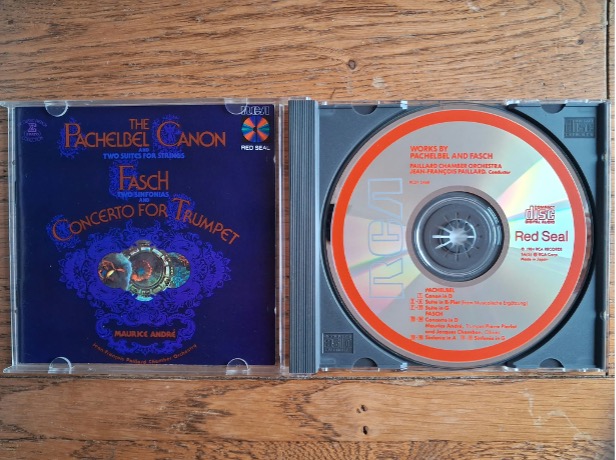
Pachelbel: Canon in D Major / Paillard - RCA/Erato RCD1-5468 (Japan for US First Press, inner ring matrix Denon 1A1 53). Jean-François Paillard, the sole reason the Pachelbel Canon is famous today, conducted The Paillard Chamber Orchestra recorded in the Cathédrale Notre-Dame-du-Liban de Paris. The 1968 Paillard recording captures a specific moment in time where the artistry and the technology aligned perfectly. By letting the music flow with that natural, breathing momentum and preserving the rich, velvety texture of the instruments, it bypasses the analytical brain and connects straight to the music. Your system should be able to pull those individual players out into the room while maintaining that deep, smooth harmonic foundation is exactly why that vintage analog magic feels so alive in an excellent setup.
|
|
|
Jean Françaix's Rondino from Harmonies Du Soir/Virtuose Celloromantik |
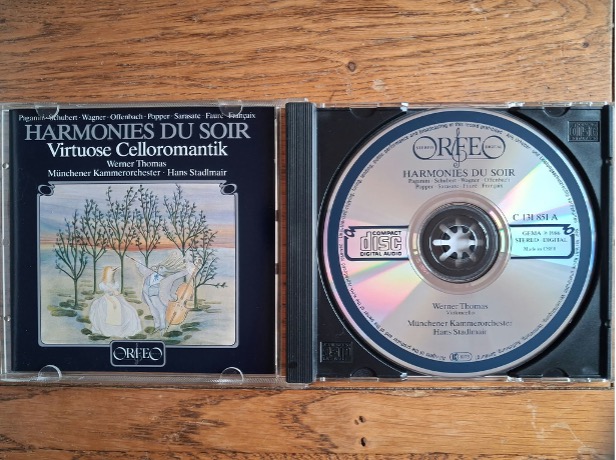
Virtuose Celloromantik Orfeo C131851 a Czech Republic pressing of Werner Thomas’s Harmonies du Soir. Münchener Kammerorchester conducted by Hans Stadlmair, solo cello by Werner Thomas. This specific copy was pressed by GZ Media (Gramofonové Závody) in Lodenice, Czech Republic. GZ’s early classical glass mastering was phenomenal—these Czech pressings are prized for their highly stable physical block structures and low digital jitter, translating directly to an exceptionally quiet, black background.
The start and stop of each plucked or short-bowed note is well defined. If your amplifier handles transient decay with zero overhang, the cello shouldn’t sound smeared; instead, it behaves like a physical acoustic engine suspended in the air.
There is a "teasingly limping" syncopated rhythm where the cello and the Munich chamber strings playfully hand motifs back and forth. A system with accuracy timing will make this complex rhythmic hand-off feel effortlessly cohesive.
HF (9/26)
欣欣音響唱片 第一期15樓G室 金豐工業大廈 大連排道144-150號 香港新界葵涌 |
Yan Yan LP
Flat G, 15th Floor, Block 1
Goldfield Industrial Building
144-150 Tai Lin Pai Rd
Kwai Chung, Hong Kong
|
有關銷售,送貨等問題: 與唱片相關的問題: |
|
|
|
網頁:24/7 辦公/交收時間: 星期一至六: 11pm - 7pm 星期日及公眾假期:休息 |
Website hours: 24/7 Working hours: Monday to Saturday 11pm - 7pm Sunday and PH Closed |
|
 Whatsapp:
 WeChat ID: yanyanlphk
 Facebook:
  Wordpress:
  Youtube: